
Application of Mathematics Competency
Principles of Mathematics Competency
Our project involved designing and building air rockets constructed primarily from cardboard (body tube, nose cone, fins) and duct tape, then launched by compressed air. The goal was to achieve maximum height while ensuring stable flight and durability. Challenges included predicting and measuring altitude, accounting for drift, and optimizing designs for minimal drag.
Specific Problem Solved Using Mathematics
Determining the rocket's maximum altitude (apogee).
We used ground-based trigonometry tracking. From a known baseline distance on the ground, we measured the elevation angle to the rocket at its highest point using a clinometer.
Launch Geometry & Tracking Setup
Figure 1 — An observer at a known baseline distance uses a clinometer to measure elevation angle θ to the rocket at apogee.
Math Application: Trigonometry (SOH-CAH-TOA)
Because the rocket travels roughly vertically from the launch pad and the observer stands on flat ground, the launch pad, the observer, and the rocket at apogee form a right triangle. Right-triangle trigonometry gives us the relationship between the known baseline and the unknown altitude.
← This is the ratio we used
- Opposite (h) — unknown rocket height
- Adjacent (d) — ground baseline, 150 ft, measured with a surveyor's wheel
- Angle (θ) — elevation angle measured with a clinometer
Derived Formula
tan θ = h / d
⟹
h = d × tan(θ)
⟹
h = 150 × tan(θ)
Solving for h by multiplying both sides by d (150 ft).
Height Computations — Recorded Data
Using the 150 ft baseline, we recorded elevation angles at apogee across multiple launches and applied the formula to compute each rocket's maximum height.
| Launch | Angle θ (°) | tan(θ) | Baseline d (ft) | Height h = d·tan θ (ft) |
|---|---|---|---|---|
| R1 | 25° | 0.4663 | 150 | ≈ 70 ft |
| R2 | 10° | 0.1763 | 150 | ≈ 26 ft |
| R3 | 20° | 0.3640 | 150 | ≈ 55 ft |
| R7 | 20° | 0.3640 | 150 | ≈ 55 ft |
| R8 | 15° | 0.2679 | 150 | ≈ 40 ft |
| R9 | 15° | 0.2679 | 150 | ≈ 40 ft |
| Observed range | 26 – 70 ft | |||
Values cross-referenced with field notebook records. Some angles repeated across launches indicate consistent drag behaviour for a given design iteration.
Field Notebook — Calculations & Sketches
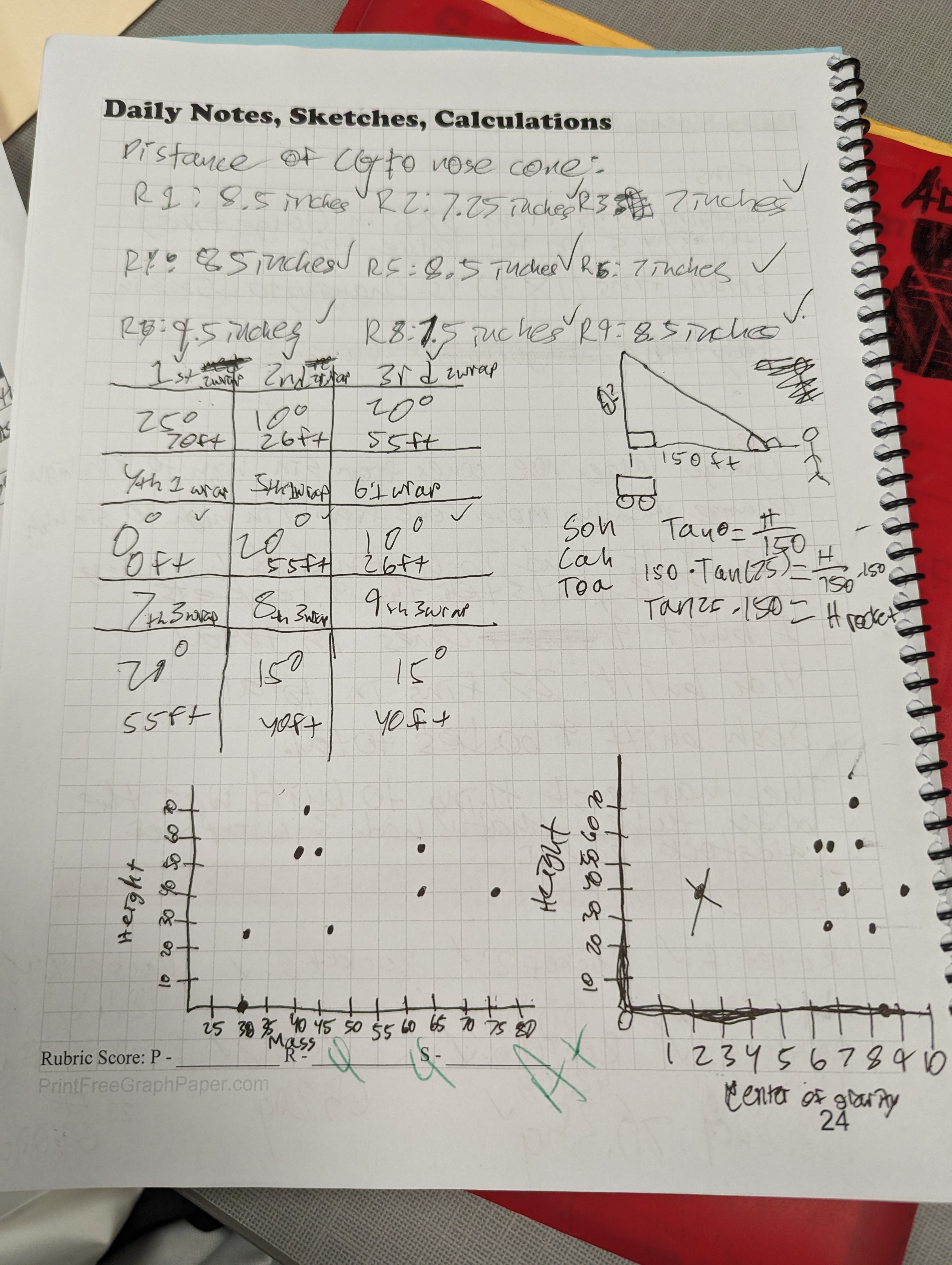
Handwritten engineering notebook showing angle measurements, tan computations (tan 25° · 150 = Hrocket), distance of CG to nose cone per rocket, and scatter plots analysing height vs. mass and center of gravity.
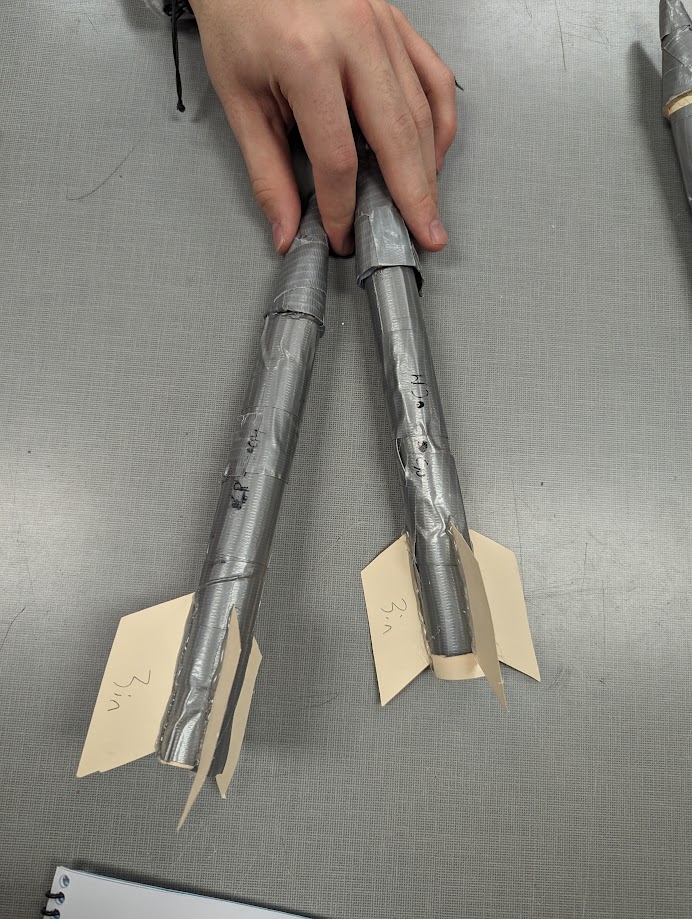
Rocket designs for reference.
Analysis & Engineering Insights
The computed heights (26–70 ft across all launches) established a measurable benchmark for comparing predicted versus actual performance. The trigonometric method gave us an objective, repeatable way to quantify design changes.
Design Flaws Revealed
Launches reaching only 26–40 ft (θ ≤ 15°) correlated with oversized fins that increased drag and damaged nose cones that disrupted laminar airflow, both visible in the notebook's scatter plots.
Iterative Improvement
Trimming fins and reinforcing nose cones pushed angles toward 20–25°, nearly tripling altitude from the lowest runs. Each iteration was justified by the computed h values, making mathematics the direct driver of design decisions.
Drift & Measurement Uncertainty
Horizontal drift meant the true apogee could be slightly off-axis from the baseline, introducing a small cosine error. We mitigated this by positioning the observer perpendicular to the dominant wind direction.
Center of Gravity Analysis
The notebook's CG scatter plot (height vs. CG position) showed that rockets with the center of gravity closer to the nose cone achieved greater stability and higher altitude, a finding consistent with the Barrowman equations for model rocketry.